
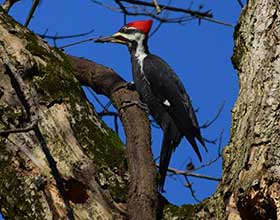
 Pileated woodpeckers never fail to impress. The first sign of their presence usually is auditory—the wild, laugh-like call, or the heavy jackhammering on a trunk. Those sounds were even used to simulate jungle ambiance in some old Tarzan movies. The whoosh of approaching wings often comes next. Then, the white wing patches flash among the trees, and the brilliant red crest shimmers in the light. So cool!
Crow-sized pileated woodpeckers are the largest of Ohio’s seven woodpecker species. Like all but one of those (the migratory yellow-bellied sapsucker), they are year-round residents, pretty much equally abundant in all months but easiest to view while the trees remain leafless. Nesting begins in spring, with chicks typically fledging in June or July. Pileated woodpeckers mostly eat insects, which they seek both up in large trees and, especially in winter, from fallen timber. They also may visit winter bird feeders, especially for suet.
Pileated woodpeckers are primary cavity excavators, meaning that they construct their own tree holes. These come in two main varieties, nest holes and roost holes. Nest holes—usually just one per tree—are built in trees that are solid but with heart rot. Entrances are round or slightly oval, about 12 cm (5”) high x 9 cm (4”) wide. Inside, the cavity expands, with an internal diameter of about 20 cm (8-9”). Pileated woodpeckers often excavate more cavities than they need for nesting, and they excavate new nest cavities each year.
Separate holes, often more than one per tree, are usually constructed for nighttime roosting. Roost holes tend to be excavated in less solid trees, often those hollowed out by insect activity and rot. Roost cavities have more oval-shaped openings than nest holes and are slightly larger in both entrance and internal diameter. In addition to those fully excavated holes, pileated woodpeckers also leave irregularly shaped feeding cavities as they extract carpenter ants, a favored food.
All of those tree holes, from nesting, roosting, and feeding, provide a valuable resource for a wide variety of other species and processes. On that basis, pileated woodpeckers are considered to be a keystone species, meaning that they have a critical role in shaping their ecological community. Keystone species are central hubs in ecological networks.
Not surprisingly, woodpecker holes affect the trees themselves, often accelerating the demise that was initiated by beetles, carpenter ants, and fungi. But beyond that, pileated tree holes are used by many other animals for their own roosting or nesting. Secondary cavity nesting birds–those that nest in holes made by other species—include chickadees and titmice, bluebirds, smaller woodpeckers, screech and barred owls, wood ducks, kestrels, and others. Those birds and others also may use the holes as retreats during winter. Mammals, too, take advantage of the tree holes created by woodpeckers; bats roost in them, and numerous species, including raccoons and gray, fox, red, and flying squirrels, may occupy the holes for nesting and roosting. Those animals also benefit from access to the insects that are exposed by woodpecker excavations.
The requirement for large trees—big enough to construct nest and roost holes—is key to the distribution and abundance of pileated woodpeckers. Humans deforested much of Ohio by the early 20th century, followed by substantial recovery in the decades since. Pileated woodpecker populations have tracked that history. As recently as the early 1960s, this species was rare and not known to nest in the Miami Valley. Lucky for us, today they occur and nest all across the region. Still, though, pileated woodpeckers are never abundant. A breeding pair occupies a territory of 100 acres or more, larger than many of the forest remnants in Ohio’s agricultural and urban landscape. Moreover, pileated woodpeckers resist flying across large treeless expanses.
So, these ecologically important birds need forested pathways for dispersal, and even in parks they will be substantially missing if land management includes the removal of decaying large trees (often done to promote human safety) or fallen logs (critical to the birds for winter feeding). These birds are an awe-inspiring part of our natural heritage. Let’s hope that they’re here to stay!
Article and photo contributed by Dr. David L. Goldstein, Emeritus Professor, Department of Biological Sciences, Wright State University.