
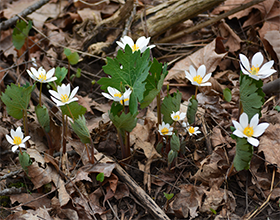
 Poppies! Just the scent of them famously sent Dorothy and her Wizard of Oz companions into a deep slumber. In our local parks, our meadows are more likely to be filled with stands of goldenrod or partridge pea. But a handful of wildflowers from the poppy family do grow scattered in our woodlands. Bloodroot, Sangunaria canadensis, is one of those, and it is not without its special powers.
Bloodroot pokes up through the leaf litter just as the calendar hits March, with its single bud and stalk sheathed inside a tightly furled gray-green leaf. The stalk grows so that the flower eventually opens just above the margin of the still partially curled leaf. The flower’s pure white petals — 8 – 15 or so of them — surround a central disc of bright yellow stamens.
Those attractive flowers close at night, open only if the days are warm enough, and bloom for just a couple of days. So, bloodroot’s opportunity for pollination is limited. Moreover, the flowers don’t produce nectar. Despite all that, early spring bees like mining bees visit to collect pollen, which provides valuable protein for their broods back in the nest.
Propagation of bloodroots can occur via seeds, which are spread in part by ants, or vegetatively from underground runners (rhizomes). Those spreading rhizomes result in clusters of plants that stand out among the spring woods flora. Flowering season lasts for just two to three weeks. However, unlike many spring wildflowers, bloodroot plants do not immediately disappear from the landscape after they bloom. Rather, fruits remain on the plant all the way through late spring, and green leaves persist as late as August or September. Bloodroots usually are designated as spring ephemerals—the woodland wildflowers that quickly come and go each spring—but they’re not so ephemeral after all.
As both the common name (bloodroot) and the genus name (Sanguinaria) suggest, a characteristic feature of this plant is the blood-red latex that seeps from a cut stem or root. That latex is rich in a alkaloids, a large group of chemicals that includes well known examples like morphine (also from a poppy), caffeine, and nicotine. In bloodroot, the alkaloids belong to a subtype called quaternary benzophenanthridine alkaloids; sanguinarine is the most abundant constituent and occurs at highest concentration in the rhizomes. The plant probably produces alkaloids to deter pests like insects, bacteria, fungi, and nematode worms. However, it has been known for a long time that those chemicals have activity in humans, too.
Historically, a number of Native American peoples of the eastern U.S. used either infusions (tea) or inhaled powders of bloodroot to address a wide range of medical issues, including colds and fevers, gastrointestinal disorders, reproductive complications, and others. Bloodroot extracts also were applied topically, both as a dye and to help heal wounds, burns, and gangrene. European settlers in North America adopted and expanded upon those applications. A concoction of bloodroot with zinc chloride (ZnCl) was first reported as an anti-cancer agent in the mid-1850s.
Today, medical uses of bloodroot persist on two fronts. On the one hand, more than 150 years later, “naturopathic” medicine continues to promote the bloodroot/ZnCl concoction, usually termed “black salve,” as a home remedy for various skin ailments. Of concern with this treatment, different plant extracts have varying, unknown doses of numerous bio-active chemicals. Moreover, some of those constituent chemicals are quite toxic, risking scars and other harmful consequences.
At the same time, the more controlled biomedical/scientific approach seeks to test the effectiveness of known concentrations of defined chemicals, with particular focus on sanguinarine. Sanguinarine still is acquired mostly as an extract from bloodroot and other plants rather than being synthesized in labs. Sanguinarine interacts with several cellular processes and pathways, conferring potential therapeutic efficacy against a variety of cancers and potentially some forms of inflammation and infectious disease. However, investigations continue to reveal potential dose-dependent dangers from the application of sanguinarine. The compound remains in use in both human and animal medicine, but it seems likely that additional studies will guide the development of safe and effective application regimens.
For now, it’s best just to seek out bloodroot as a beautiful sign of spring. April showers might bring May flowers, but it’s the warming days of March—in like a lion, out like a lamb—that really kick off wildflower season in Southwest Ohio. Our local poppies hold notably potent chemical secrets, but really, their primary power is to rejuvenate the spirit: Toto, we’re not in winter anymore!
Article and photo contributed by Dr. David L. Goldstein, Emeritus Professor, Department of Biological Sciences, Wright State University.