
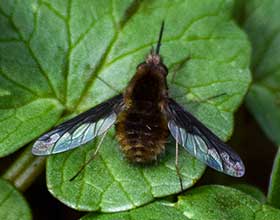
 You hear a buzz. You see a fuzzy insect heading for a flower. Naturally, you think, “bee.” But something’s not quite right. The insect hovers, and it has a long, pointy “nose.” That’s no bee; you’ve spotted a bee fly!
Bee flies are actually flies — two-winged insects in the order Diptera — but as both their common name (bee fly) and their family name (Bombyliidae, from the Greek root meaning “buzzing”) suggest, they resemble bees. A dozen or more bee fly species inhabit Greene and Montgomery Counties. Our three most commonly encountered species effectively divide up the annual flowering season. Aster bee flies — small, plain brown, and easily overlooked — surge in abundance in September. Tiger bee flies, with ornately patterned wings, appear in July and August. But springtime — especially April — is the season for greater bee flies, Bombylius major.
Greater bee flies have features typical of the bee fly family. First, they are notably fuzzy, in a cuddlier-looking way than bumblebees or moths. Second, bee flies at rest hold their wings laterally, rather than folded over the body as in bees. In greater bee flies, those wings have an attractive black patterned front edge. Bee flies are adept at hovering, and the wings produce a noticeable buzz during flight. And third, greater bee flies have a long “nose” (proboscis), on the long side even for bee flies. The proboscis is used to drink flower nectar, facilitated by muscles that create suction. It looks a little scary, but it is incapable of biting or stinging. The combination of fuzzy body and long proboscis makes it hard to describe bee flies without using the word “cute”!
While feeding on nectar, bee flies may inadvertently pick up pollen. (Bee flies do not need to actively collect pollen because, as described below, their offspring acquire that protein-rich food by other means.) Some of that pollen is then deposited on other flowers that are visited later. As a result, bee flies are effective and important pollinators. Moreover, long-nosed species, like greater bee flies, apparently visit a greater variety of flowers than short-nosed species, presumably because the longer proboscis provides more versatile access to nectar. Spring wildflowers that are pollinated by greater bee flies include spring beauties, trout lilies, wild geranium, purple cress and others.
The combination of buzzing flight and fuzzy body gives the flies their resemblance to bees. That resemblance is not just a point of human confusion, though. Rather, bee flies have strong motivation for fooling actual bees. The reason lies in their reproductive habits.
Bee flies do not build their own nests. Instead, they are parasitoids, meaning that they take over, and ultimately kill, a host animal. For local bee flies, that host is typically a species of solitary bee, like various species of miner bees (Andrena species). A female bee fly surveils her habitat, looking for bee nests. When she locates one, she waits for the female bee to depart, then hovers over the nest entrance and “shoots” her eggs at the target. In some bee flies, the female may even adhere a few sand grains to the eggs before ejecting them, giving them a big of extra weight that improves targeting!
When a bee fly egg hatches, the larva crawls into the reproductive chambers of the host bee nest. There, the larva eats the provisions (e.g., pollen) that the host bee has accumulated to support its brood, then goes on to devour the host offspring. That behavior is usually described as a version of parasitoidism, but it’s sort of a form of predation, too. Cute, but not cute!
Once the bee fly larva has accomplished its mission of consuming all available food in the bee nest, it proceeds through metamorphosis to the pupa stage. That pupa overwinters until the adult emerges in spring.
So, giant bee flies and their kin exemplify two phenomena that are widespread among insects, mimicry and parasitoidism. The commonness of those strategies reflects their success in promoting the primary biological objectives, to survive and reproduce. The cuteness factor is just a lucky by-product!
Article and photo contributed by Dr. David L. Goldstein, Emeritus Professor, Department of Biological Sciences, Wright State University.