
 Violet, lilac, lavender, orchid, mauve: all names for shades of the color purple, and all named for flowers (mauve from the French word for mallow). That etymology reflects both the relative commonness and the beauty of purple flowers. “Purpleness” in flowers derives from pigment chemicals — anthocyanins — that plants synthesize. Anthocyanins absorb some wavelengths of light but reflect others. We see that reflected light and interpret it as blue or purple.
In contrast to plants, animals don’t produce anthocyanins, nor do they store dietary anthocyanins. So, purple animals must produce their color using other mechanisms. For an animal to appear purple to us, it needs to reflect both red and blue light; our brain concocts the perception of purple from that combination of wavelengths. Animals do have pigments (melanins that they synthesize, and carotenoids from their diet) that reflect red wavelengths. But without anthocyanins, where does blueness (and, so, purpleness) come from?
Birds like blue jays, bluebirds, and indigo buntings provide one solution. Their blue color is “structural” rather than pigment-based. Blue wavelengths of light are scattered out by microscopic structures within the feathers, while other wavelengths are absorbed. The result in those bird species is blue coloration with a “matte” appearance — rich and solid — because the blue wavelengths are scattered in all directions. In other cases, like the head and wings of a tree swallow, the color is iridescent; it’s shiny and depends strongly on the angle of light and viewing. That iridescence also is produced by light scattering, but from smaller microstructures within the feathers that scatter only in specific directions.
Unlike those birds, some insects do, in fact, produce pigment chemicals that reflect blue light. Pteridine and ommochrome pigments probably generate the matte blue coloration of local dragonfly and damselfly species like blue dashers and stream bluets. In contrast, insects that shimmer with iridescent blue, like the wings of tailed blue and pipevine swallowtail butterflies, do so by way of light scattering, just as in birds. Interestingly, feathers and insect wings are constructed of different materials — the protein keratin and the carbohydrate chitin, respectively — and so those microstructures may scatter light similarly, but they evolved independently.
Whereas blue animals seem fairly common and diverse, it’s harder to think of purple examples. Even some of our local critters that are called “purple” are, in fact, imposters. For example, the Audubon Society notes that purple finches — mostly here as winter visitors — are “not really purple,” and their raspberry blush derives from dietary, plant-derived carotenoid pigments, just like the red coloration of cardinals. Red-spotted purple butterflies are likewise misnamed; they have stunning, shiny blue upper wing surfaces (and reddish spots beneath), but not a trace of purple. Go figure!
Most of the truly purple local examples are of the glossy, iridescent variety. Male mallard ducks are a good example: both their head and their wing patches (specula) can shine purple in the right light, though with other lighting they appear green or blue, respectively. Among local insects, the common buckeye butterfly — a beautiful late summer species — has eyespots on the upper hind wing that, in the right light, flash brilliant purple. In each of these cases, iridescent purple is created by light scattering that allows both blue and red wavelengths to reach our retinas.
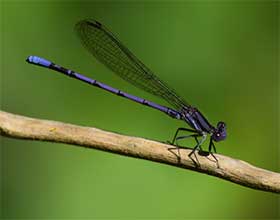
The one local animal that really is purple, of the solid “matte” variety, is an insect. Violet dancers, Argia fumipennis violacea, a subspecies of the variable dancer, are small, dainty damselflies. Most of Ohio’s eight Argia species have males patterned with bright blue spots and patches. In violet dancers, though, much of the male’s abdomen is vivid, solid purple, and the thorax alternates black and purple stripes. You know a violet dancer when you see one!
The basis for the violet dancer’s coloration has not been specifically studied. It seems likely, though, that it’s based in pigments, quite possibly a combination of pteridines and/or ommochromes (reflecting blue) and melanins (reflecting red). Another possibility is that light scattering contributes; in some birds, structural blue (light-scattering) is coupled with pigments to produce either green feathers (using yellow pigment, in many parrots) or purple (using red pigment, in the tropical purple-breasted cotinga).
Whatever the specific basis for the violet dancer’s coloration, it’s always a treat to see a bright purple animal. The color purple has long been valued by humans and often is associated with kings. So, while violet dancers may be small and dainty, really, they are insect royalty!
Article and photo contributed by Dr. David L. Goldstein, Emeritus Professor, Department of Biological Sciences, Wright State University.