
 In the famous opening scene of Forrest Gump, a mostly-white feather floats down from the sky to land at Forrest’s feet. If that feather were, instead, to float down toward one of our local summer meadows, it might well never reach the ground. Instead, it would be plucked from the sky by a shiny blue aerialist and, like Forrest’s feather, tucked away for safekeeping. After all, mostly-white feathers are the favorite nest adornment of tree swallows.
Tree swallows—Tachycineta bicolor—arrive in Ohio each spring and breed through the summer. During that breeding season, their diet consists almost exclusively of insects, captured on the wing. So, when insect abundance declines with autumn cooling, tree swallows head south for richer hunting grounds. They spend winter in the southern US through Central America.
Tree swallows are named for their habit of nesting in tree holes; they particularly like holes created by woodpeckers. However, other options also can suffice, and bluebird nest boxes are perfectly fine. A local set of bluebird boxes may well end up occupied by more nesting pairs of tree swallows than of bluebirds.
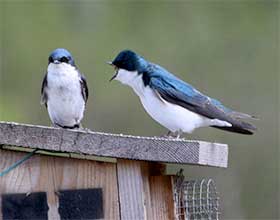
An active tree swallow nestbox can be rather conspicuous. During the phase of nestbox occupancy and nest building, the parents are notably vocal. Their mellifluous chattering is persistent both at rest and in flight, and a pair of tree swallows perched on a nestbox often engages in lively conversation. A single tree swallow nesting cycle may include six or more eggs, so there’s a lot of coming and going once the chicks hatch. Throughout that cycle, the birds vigorously defend their chosen nestbox, swooping down on other birds that might approach and even dive-bombing much larger intruders, including humans.
Tree swallows weave their nest cup out of dried grasses, and like many birds they line that cup with feathers, which they seek out and collect. As an unusual final touch, tree swallows finish off the nest with a collection of larger feathers stuck into the cup rim so that they hang over the nest as a canopy.
Those canopy feathers are usually white, or mostly white. A study of tree swallow nests in Ohio and Indiana found feathers from more than two dozen species, including wild turkey, killdeer, red-tailed hawk, great horned owl, catbird, and others. However, body feathers from ducks, including mallard and wood duck, are ideal for the canopy, and swallows gather them from considerable distances. Highly regarded nature writer Bernd Heinrich wrote an entire book, “White Feathers,” describing his multi-year observations of tree swallows in Maine, stimulated by finding white feathers in a nest far removed from any obvious source of those materials.
The function of those canopy feathers remains a subject for debate. One possibility is insulation; a layer of feathers over the eggs and chicks will certainly help to retain heat required for development. The canopy also might protect against intruders. In particular, other tree swallows—but also cowbirds and other species—sometimes lay their eggs in tree swallow nests, forcing the resident parents to raise foster chicks. The white feather canopy may obscure the eggs in a way that discourages freeloading egg layers. A third possibility is that the white feathers signal nest occupancy to other swallows during the period of nest site selection, thereby avoiding conflict over potential nest sites. All of those reasons might contribute.
Although the “white feather strategy” might reduce heat loss or avian intruders, these days it’s another threat that’s more challenging for tree swallows. That threat is the declining availability of aerial insects, including both an overall decline (the so-called “insect apocalypse”) and, as a result of warming climate, a shift in the timing of peak insect abundance, especially for wetland insects, relative to swallow breeding season. The result is that swallows and other aerial insectivores (swifts, nighthawks, and flycatchers) find it increasingly difficult to harvest sufficient food for themselves and their offspring. About three-quarters of North America’s aerial insectivores—more than any other group of birds—are in decline. Tree swallow numbers have dropped by something like 30% over the last several decades.
As Forrest Gump’s momma might have said, life is like a box of songbirds; you never know what you’re gonna get. Put up a bunch of bluebird boxes, and sometimes you’ll get bluebirds. But sometimes you’ll get iridescent, acrobatic, chattering tree swallows. Let’s hope that their numbers rebound as successfully as has been the case for bluebirds. “And that’s all I have to say about that.”
Article and photo contributed by Dr. David L. Goldstein, Emeritus Professor, Department of Biological Sciences, Wright State University.