
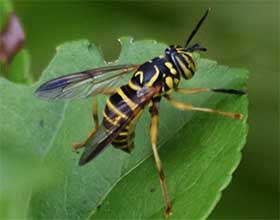
 Within the insect order Diptera—the flies—the family Syrphidae is one of the largest groups, with more than 6,000 species described worldwide. Syrphid flies have several notable characteristics. First, adults commonly feed on nectar and pollen, giving the group a common name of “flower flies.” You can find them in most gardens and meadows. Second, syrphids often hover, partly as a strategy to locate food (they don’t actually feed while hovering) but also in territorial displays and in search of sites to lay eggs. That behavior provides an alternative common name, “hover flies.” Last, although syrphid flies themselves are harmless—they don’t bite or sting—many species have patterns, coloration, and behaviors that mimic stinging wasps and bees. Here in southwest Ohio, we have some amazing examples of that mimicry. The eastern hornet fly, Spilomyia longicornis, is among the best.
Eastern hornet flies resemble wasps in a number of ways. Most obvious is their overall appearance, which quickly brings to mind yellowjackets or related stinging wasps. Like many hover flies, Spilomyia is colored black and yellow. But to enhance their mimicry, they have two yellow stripes per abdominal segment (tergite). That gives the appearance of a 6-tergite wasp abdomen rather than a typical hover fly, which has just 3 main tergites. In addition, Spilomyia have rounded abdomens with coloration suggesting a constricted waist, all reminiscent of wasp-like body form.
Wasps, like most insects, have four wings, whereas flies, including hornet flies, have just two. So, that would seem like an easy clue for distinguishing one from the other. However, hornet flies have dusky edging to their wings that resemble the overlapping wings of a wasp; the fly’s two wings are easily confused for a wasp’s four.
Wasps and flies also differ in head structures. A wasp’s eyes sit mostly laterally, whereas in flies they extend over the top of the head, even meeting midline in male hornet flies. But the hornet fly’s eyes are patterned with dark and light bands that obscure their size and placement. Likewise, wasps have long, mobile antennae, whereas those of hornet flies are short and stubby. So, when a hornet fly is disturbed, it waves its two front legs across the front of its head, looking for all the world like wasp antennae. Pretty clever!
At least two driving forces have been proposed for the evolution of wasp mimicry in hover flies. One idea is that wasp-mimicking flies gain access to food, because other insects avoid landing on flowers already occupied by a stinging wasp. However, a test of that hypothesis concluded that insects did indeed avoid already-occupied flowers, but wasp-mimics had no advantage over other insects.
A second, probably more obvious, idea is that wasp mimicry discourages predators, which prefer to avoid prey that might sting. There is little question that humans can be fooled by wasp-mimicking hover flies. But are potential predators fooled, too? A recent study from the UK, using 3-D-printed versions of stinging wasps and varyingly-accurate wasp mimics, tested this idea. A variety of potential predators, including praying mantises, spiders, and wild birds (great tits, similar to our chickadees) were presented with choices of “prey” items. Both the invertebrates and the birds avoided trying to eat the wasp models and their mimics. However, birds were more discriminating, less likely to be fooled by less accurate mimics. These particular birds were influenced more strongly by the insects’ color and size than by their pattern and shape. Bottom line: mimicry does indeed provide protection against predators, but the specific traits providing that protection might vary depending on the predator.
Syrphid flies have been fooling birds for a long time. The earliest evidence of a wasp-mimicking hover fly comes from an amazing 33-million-year-old fossil Spilomyia, which perfectly preserves a pigmentation pattern just like modern hornet flies. At that time, the predominant insect-eating birds included relatives of modern-day kingfishers and swifts, rather than the songbirds of today. So, mimicry in hover flies has persisted for millennia, even while the avian predators around them have changed.
Hornet flies are quite generalist as pollinators. Their local abundance peaks in September, so look for them on goldenrod, snakeroot, asters, and other late-season wildflowers. The overall mimicry—and those striped eyes!—are so cool; you won’t be disappointed when you spot one!
Article and photo contributed by Dr. David L. Goldstein, Emeritus Professor, Department of Biological Sciences, Wright State University.