
 For a lot of gardeners, the definition of a weed — any plant that grows where it’s not wanted — applies perfectly to goldenrods. After all, goldenrods disperse widely, grow readily, and look rather unruly, especially after flowering season. On the other hand, goldenrods are such a rich source of pollen and nectar in late-season meadows that they also fit the definition of a keystone species — that is, an organism that plays a critical role in shaping its ecosystem. For late summer/early fall wildlife, there’s gold in them thar meadows!
Ohio is home to something like two dozen species of native goldenrods. All are placed in the genus Solidago within the family Asteraceae, alongside sunflowers, daisies, asters, and many other wildflowers. Some goldenrods occupy restricted ranges or grow in relatively secluded or specialized habitats. But several species are widespread and provide the glowing yellow hue of Ohio’s late-season meadows and woods edges.
The conformation of goldenrod plants varies. Two common local species — Canada goldenrod (S. canadensis) and tall goldenrod (S. altissima) — have flowers held on feathery, droopy plumes — “a geyser of little gold daisies,” in the words of Robin Kimmerer. In contrast, flowering heads of stiff-leaved goldenrod (S. rigida) form a platform, while others, like broad-leaf goldenrod (S. flexicaulis), blossom on upright spikes. To some extent, that conformation influences the variety of insect visitors. Many larger butterflies and wasps, for example, tend to prefer the more robust platforms over the droopier plumes. On the other hand, monarchs, which visit goldenrods to help fuel their southward migration, commonly hang from the plumed varieties.
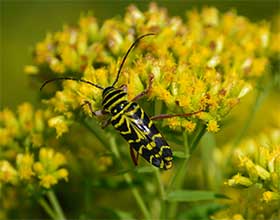
Goldenrods produce a large number of flowers, each offering a combination of nectar (sugar water, a great source of calories) and pollen (full of fats and protein). Those nutrients attract a diverse insect community. One citizen science project in Pennsylvania, documented on iNaturalist.org, identified about 175 species of insects visiting goldenrods. Some of those are generalists that visit a wide diversity of flowers, but others specialize. Locust borer beetles — ornate yellow and black beetles with maroon legs and long black antennae — fall in that latter group. Their larvae feed under the bark of locust trees, but the adult beetles emerge just in time to seek out goldenrod pollen. Likewise, something like 40 species of bees, including several that occur locally, specialize in visiting goldenrods.
It is not uncommon for several species of goldenrods to occupy the same meadow, but a single species may come to dominate. Canada goldenrod, for example, grows tall and dense; it can shade out both other goldenrod species and fall-blooming asters, which are relegated to blooming at the edges where light is more available. In Europe, Canada goldenrod has been introduced and is considered invasive, as its dense growth can crowd out other native plants.
Goldenrods deal with highly variable environments. Many goldenrod species thrive in disturbed habitat, which can become available at any time. As late-season bloomers in north temperate climate zones like ours, they also deal with variable weather that can affect availability of pollinators. As a result, goldenrods are thought to benefit from genetic variability, and even within a single species there can be substantial variation in traits like growth rate, the timing and extent of flowering, and the production of chemical defenses. A study in Minnesota documented that early-blooming genotypes of tall goldenrod attracted more pollinators, but later-blooming versions might be able to take advantage of additional disturbance events and insect visitors.
J. R. R. Tolkien, in a play on the famous Shakespeare quote, wrote that “all that is gold does not glitter.” His meaning — that an object’s true value might not be immediately obvious — could well be applied to goldenrods. Goldenrods are denigrated as weeds, and they are often blamed, undeservedly, for triggering fall allergies (blame Walt Disney and Sneezy for that one!). Really, though, goldenrods are both beautiful and vital to the late season ecosystem. Worth their weight in pollen, one might say!
Article and photo contributed by Dr. David L. Goldstein, Emeritus Professor, Department of Biological Sciences, Wright State University.