
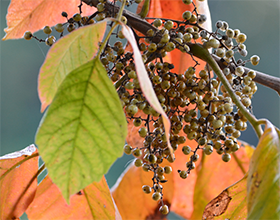
 Parents sending their kids out to explore the meadows and woods of Greene and Montgomery Counties can take comfort that we don’t have alligators, mountain lions, or poisonous snakes. But still, there are a few natural hazards out there. Among those, poison ivy is probably somewhere near the top of the “do not touch” list. “Leaves of three, leave it be!”
Poison ivy is a member of the cashew plant family Anacardiaceae, which also includes such well-known edibles as mangoes, cashews, and pistachios. Cashew-family plants take a variety of forms, including bushes, trees, and vines. Poison ivy itself can grow in several of those forms, ranging from a weedy ground cover to a rather robust shrub or a lengthy vine. Traits shared by most members of this family include small five-part flowers, fruits with thin skin and a single central seed (technically, drupes), and leaves with an alternate and compound arrangement. The simple characteristic usually used to identify poison ivy is its compound, smooth-edged, triplet leaves, with the central leaflet on a longer petiole.
Many members of the Anacardiaceae produce sap containing allergenic compounds. In fact, the scientific genus name of poison ivy, Toxicodendron, literally means “toxic tree,” and the offending chemical is an oil called urushiol. Urushiol also occurs in some human food crops from Anacardiacean plants, but in structures that can be avoided. In mangoes, for example, urushiol is substantially localized to the skin, which sensitive individuals should take care to avoid; for cashews the urushiol is removed by discarding the outer husk before marketing the nuts. In contrast, poison ivy contains urushiol throughout the plant, including roots, stems, branches, leaves, and fruits.
Despite the name “poison ivy,” urushiol is not really a poison. In other words, it is not directly responsible for harming human cells and tissues. Instead, urushiol initiates an allergic reaction. As an oil, urushiol can pass through the skin to enter underlying tissues. There, urushiol is modified (oxidized to its quinone form) and then binds to a protein (CD1) located on cellular surfaces. That molecular combination of quinone with CD1 is recognized by T-lymphocytes—cells of the immune system—as a foreign agent. Activated T-lymphocytes work to destroy targets like virus-infected cells and some cancerous cells. But in this case, they direct their destruction against skin cells, and the result is a type-IV hypersensitivity reaction—in other words, the allergic poison ivy rash.
Poison ivy unquestionably is irritating, potentially even dangerous. Nevertheless, it does have some attractive features. The first is that in autumn, the green leaves turn a beautiful array of colors, from yellow and orange to red and purple. A meadow full of poison ivy—and we have lots of those!!—can be a beautiful sight to behold in the fall.
As an additional benefit, poison ivy produces clusters of small, white fruits that ripen in autumn and can persist well into winter. Those fruits feed many animals, especially birds dealing with the cool-season lack of insects. Chickadees, yellow-rumped warblers, and downy woodpeckers are among local consumers. Poison ivy’s colorful autumn leaves probably help direct birds to the fruits. In exchange, birds provide the plant with dispersal services, as they digest the pulp but excrete the seeds unscathed.
So, how is it that birds (and also mammals like deer, rodents, and raccoons) can eat the fruits without suffering adverse reactions? The first answer to that question is simple: feathers and fur limit access of urushiol to the absorptive skin surface. No contact, no rash.
But why no reaction to taking the fruits internally? As noted above, the trigger for the human allergic reaction is the binding of urushiol to CD1 protein. It turns out that mammals have several CD1 genes, each resulting in a different variant of the protein. And the version responsible for urushiol binding in humans, CD1a, is absent in most mammals. Birds have even fewer CD1 genes and lack an urushiol-binding variant. As a result, birds and most mammals—with the exception of a few primates and, for some reason, guinea pigs—are unreactive to urushiol.
Those positive attributes of poison ivy are great, but they aren’t likely to add it to many people’s list of favorite plants. Don’t make a bouquet out of those beautiful fall leaves, and don’t decorate your dessert with those white fruits! Leaves of three: leave it for the birds!
Article and photo contributed by Dr. David L. Goldstein, Emeritus Professor, Department of Biological Sciences, Wright State University.