
 Edwin Way Teale, one of the mid-20th century’s preeminent nature writers, repeatedly traversed the US and chronicled his observations and reflections in his “American Seasons” books. In his later years, though, Teale settled into a New England home on 168 acres of land, and his focus shifted more locally. The resulting volume, A Naturalist Buys an Old Farm, has long inspired me, and it continues to provide a valued perspective: there is much to learn and appreciate right in one’s own backyard!
Lucky for me, my backyard happens to be Bill Yeck Park. In recent years, I have tried to attend more closely to the diversity of life in those 200 acres. Insect life—by far the most diverse animals—has been a big part of that. So, my routine has been to combine my daily excursions in the park—usually with my dog—with my enjoyment of photography and of biodiversity. What’s out there?
It turns out that taking pictures has a benefit beyond just enjoyment. That is, I could post my sightings to the website iNaturalist.org (“iNat”), the public database for recording photo-documented observations from nature. iNat now includes about 4 million observations from Ohio, a quarter of which are insects, and so it provides substantial context for one’s own observations. Here, I briefly recap a few findings for 2025. Perhaps there are some lessons to be learned.
Over the past decade or so, I have documented about 55 butterfly species in Bill Yeck. In 2025, I saw 44 of those. Of the 10 or so “missing” species, a few are uncommon in any year; checkered white and harvester are good examples. However, others were noticeably down in numbers from what I had come to expect. For example, Bill Yeck usually has a good number of four yellow “sulphur” butterflies in late summer. This year, two of those (orange and clouded sulphurs) were abundant as usual. But two others, the cloudless sulphur and the little yellow, were virtually missing. In fact, Bill Yeck was the top place in Ohio for reports of little yellows in 2024 (20 reports, out of 120 statewide), but there were 0 in 2025. Other species “missing” from Bill Yeck in 2025 included giant swallowtail (Ohio’s largest butterfly), wood nymph, and fiery skipper. Those local findings were mostly consistent with statewide patterns. Cloudless sulphurs, little yellows, and fiery skippers, for example, were down in numbers across Ohio.
On the other hand, some species had really good years. Black swallowtails were abundant, and monarchs surged in late summer. Likewise, zebra swallowtails, which are near the northern limit of their range in Ohio, were unusually abundant in 2025. For all those species, the banner year extended state-wide, with two or three times as many sightings in 2025 as in 2024.
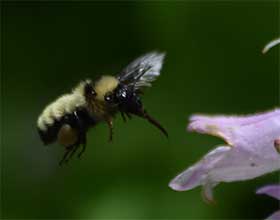
The pattern was somewhat different for bumble bees. Historically, 20 bumble bee species have been recorded from Ohio. Only about a dozen have been seen in recent years, though, and just nine of those—the nine most common—were reported in 2025. Of those, seven were seen in Bill Yeck. For one species, the golden northern bumble bee (an attractive species with a yellow abdomen and a long tongue), Bill Yeck was the top locale in the state for reports. On the other hand, just a single black-and-gold bumble bee was reported—up from 0 the previous year—and perplexing bumble bees—a fuzzy, all-yellow species—were not seen at all, as has been the case in Bill Yeck and in local counties for several years.
What lessons can we draw from these findings? The most obvious is simply that there’s a lot of diversity out there! Even a relatively small suburban park like Bill Yeck Park, with its combination of mixed deciduous forest, meadows, and creek, can be home to lots of critters.
Documenting that diversity is a challenge. Even for well-known groups with relatively modest species diversity, like butterflies, it takes a lot of wandering to capture what’s out there. That’s even harder for groups like bees, where many species are smaller, harder to photograph and identify, and more restricted in time and place. I photographed about four dozen identifiable bee species in 2025—but that’s just 10% of the number in Ohio, and no doubt there are lots yet to find. Similarly, I had to learn how to look for ichneumons—parasitic wasps, many with long wavy antennae and flashy, patterned bodies—but once I did (sunspots in autumn woods were productive sites), I saw about 30 varieties, many still not identified. iNaturalist brings the power of the community to both the documentation and the identification of all this diversity.
What do we make of the changing and differing patterns of abundance? Why is Bill Yeck so good for some species while others disappear? And for those latter: will they return? The fact that patterns in Bill Yeck substantially mirrored those across the state suggests that causes are widespread, not local (though certainly park management practices are important). Maybe 2025’s cold, wet spring affected some species more than others, for example. But even if so: was it a direct effect of temperature and/or water (and if so, at what life stage), or might it reflect some other ecosystem interaction like parasites or disease? Unraveling answers to those sorts of questions could provide critical insights into preserving biodiversity, including for critical groups like pollinators or for specific species. As the human impact on natural systems continues to change, these issues become ever more salient.
Beyond scientific and practical intrigue, exploring local biodiversity is simply fun and interesting. Among the insects are many species with amazing body forms, colors and patterns, and life histories. And there’s always the chance of discovering something entirely new. Even just the names are fantastic. I saw elephant mosquitoes, lunate longhorn cuckoo bees, oblong woolcarder bees, dragonhunter dragonflies, antlered flutter flies, blotchwing spider wasps, and tufted globetail flies. Right out of Dr. Seuss!
Almost exactly 50 years after Teale’s “Old Farm” book, renowned global explorer Alastair Humphreys published his reflections on a year spent wandering the British countryside near his home. The message of that book (Local) is similar to Teale’s: if you explore with an open mind, then even your backyard is full of wonders. I understand that not everyone gets excited by butterflies and bumble bees, never mind wasps and flies. But our natural areas provide critical functions, from ecosystem services like pollination and water purification to a sense of well-being, wonder, and refreshment. We need our parks, and we are more likely to value what we attend to. Take a closer look at the critters in your backyard and neighborhood; you might be amazed at what you see!
Article and photo contributed by Dr. David L. Goldstein, Emeritus Professor, Department of Biological Sciences, Wright State University.