
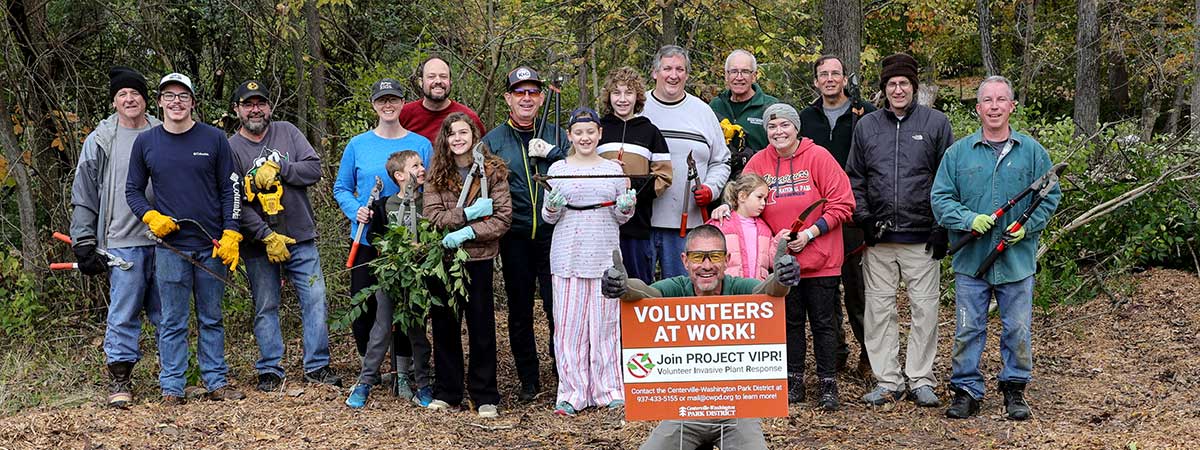
Project VIPR (Volunteer Invasive Plant Response) is a community-powered ecological restoration initiative that empowers volunteers to reclaim native habitats in the Centerville-Washington Park District. Through hands-on removal of invasive species such as honeysuckle, buckthorn and garlic mustard, Project VIPR restores biodiversity, reduces herbicide use and protects wildlife. Events, partnerships and weekly meet-ups bring families, students and community groups together to learn, work and celebrate the value of native species.
To join a weekly meet-up for the first time, contact CWPD’s Community Engagement Coordinator, Shauna Marshall, at smarshall@cwpd.org or 937-433-5155.
VIPR’s success lies in its simplicity, sustainability, and community spirit. It proves that meaningful change can be found in a shared purpose, a pair of gloves, and a love for local parks!
Bill Yeck Park: Adopt-a-Habitat
You, your family, or your group can Adopt-a-Habitat in your community’s BIG backyard!
There are 12 locations throughout Bill Yeck Park available to be maintained by community groups, families or individuals. Each area requires at least four visits per year, totaling a minimum of 30 hours of work/year, to remove invasive plants and conduct an annual survey, helping the Park District document changes at the park. A group of eight or more can finish an area in two hours!
Once you have been assigned an area, a Project VIPR leader will help you get started!
Your work will help create wonderful native areas for future generations to experience!
Current Bill Yeck Park Sections and Their Adopters
- Pawpaw – The Mazza Family
This area along Sugar Creek has had a resurgence of North America’s largest fruit, the Pawpaw! Not to mention the awesome overlook trail! - Commissioners Grove – Joe Liechty
The highlights in this area are the wetland fed by water from the parking lot, the commissioner’s grove, and the wooded area near the Smith House. - The Confluence – The Tanner Family
This habitat derives its name from the fact that the Little Sugar Creek and Sugar Creek merge here to create the larger Sugar Creek. It’s a wonderful area that borders the Secret Meadow. In the evenings, you can hear the Barred Owl that roosts in the pines south of the Secret Meadow. - Time Trail – Available
The premier area of Bill Yeck that showcases how a meadow becomes a forest. Keeping this area free of invasive species, such as the Bradford Pear, will help preserve Ohio’s native beauty for generations to come. - Sugar Valley – Centerville High School Environmental Science Career Education
Known for its multiple creek crossings and loved for its more rugged trail system, Sugar Valley and its large sycamores are incredible. - Buckeye – The Code Family
After the initial cutting of the invasives, the buckeye tree groves started to appear. One of the quietest areas in the park where you can really hear all of the woodpeckers! - Overlook – Sheri & Jeff McPherson
This trail system that meanders along the ridge is a real highlight of the park. We often see hawks and turkeys along the stream at the bottom. - Old Lane – Available
Most of this reserve area was a farm field and is now becoming a forest again. Through your continued maintenance, reforestation can continue in earnest! - Rooks Mill – Houck Menninger Law LLC
This section highlights diverse soil types and plant life. One of the first areas where the American Elderberry began to appear after the invasives were removed. - Red Fox – Available
If you keep your eyes and ears peeled, you’ll see the amphibians. The chorus frog’s songs are amazing in the spring. This is also near a red fox den. - Red Squirrel – Pending
Home to the American Red Squirrel, these little squirrels are only slightly bigger than a chipmunk, and are best known for their aggressive personality! - Wood Thrush – Available
While the audible call of the wood thrush is beautiful, they can be a difficult bird to spot. However, this area is the place to get a good look at one in early summer. Keep your eyes open: a flock of turkeys also frequents this area, particularly in the late fall.
To Adopt-a-Habitat in your community’s BIG backyard, contact CWPD’s Community Engagement Coordinator, Shauna Marshall, at smarshall@cwpd.org or 937-433-5155.
View a map of Bill Yeck Park’s Adopt-a-Habitat Locations (PDF) >