
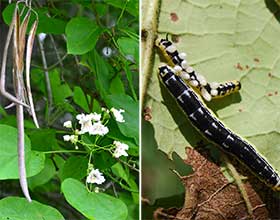
 From the spring beauties of March through the asters of November, our woods and meadows progress through a wonderful cycle of herbaceous (non-woody) wildflowers. But some of our trees also bear beautiful flowers. The vivid pinks of redbuds, the greenish spikes of buckeyes, and the flashy blossoms of tulip trees can compete for attention with any forest floor wildflower. Among the showiest of those flowering trees are the northern catalpas, Bignonia speciosa.
The catalpa family of plants is mostly tropical, with just two native species, northern catalpa and trumpet vine, common in Ohio. Catalpas are medium-sized trees, usually found in lowlands near water, often at the edges of woods. The trees’ features are easy to recognize. Their leaves are large and heart-shaped, much bigger than similarly shaped redbud leaves. The flowers — two inches (5-6 cm) across — are white with yellow stripes and purple spots inside and grow in conspicuous clusters, sometimes right at eye level. And the blossoms give way to bunches of long, dangling pods that ripen in fall and persist through winter. Catalpa branches can be somewhat fragile and messy, but still, it’s not surprising that catalpas are popular ornamental trees for landscaping.
Catalpa flowers are pollinated by a variety of insects, especially by large bees like bumble bees and carpenter bees. But, the insects that are most evident in association with catalpas are the larvae (caterpillars) of a moth, the catalpa sphinx moth, Ceratomia catalpae. The dull brown, nocturnal moths lay clusters of up to several hundred eggs on the leaf underside. Those eggs give rise to a readily visible “swarm” of feeding caterpillars, which range in color from uniformly pale yellow to mostly black. The spike at their posterior end confers the name “catalpa hornworm.” The moths can have two cycles of egg laying in a year, so it’s possible to find small, young (early instar) caterpillars feeding alongside larger, older (later instar) individuals. The caterpillars, which are favored as bait by fishermen, can be found throughout summer and can substantially defoliate all or part of a catalpa tree. Despite that, the tree usually survives in good health.
The story of insects on catalpas does not stop with the caterpillars. Catalpa hornworms often are found with a series of small white “balls” attached to their backs. Those structures are the cocoons of a parasitoid wasp, Cotesia congregata, which also attacks some other sphinx caterpillars like tomato hornworms. Cotesia females inject their numerous eggs into a caterpillar, where they hatch into wasp larvae. The larvae progressively consume the caterpillar until they (the wasp larvae) are ready to metamorphose to the next stage (pupae). At that point, they exit the caterpillar host and spin their small cocoon, attached to the back of the host. The next generation of wasps emerges from those cocoons.
To accomplish all that, the wasp needs the caterpillar to live long enough, and not to bury down into the ground to complete its own metamorphosis into a moth pupa. The wasp has some tricks to assure those objectives. First, it consumes the caterpillar’s innards in a sequence that does not kill the host; non-vital organs go first. And second, the wasp inhibits the caterpillar from completing metamorphosis, using a combination of chemicals produced by the female wasp (injected along with the eggs) and by the eggs themselves. The net result is “zombie caterpillars” — animals that are just a shell of themselves, walking around with their back covered in wasp cocoons.
And that’s not all! An even smaller wasp — lilliputian, even — attacks Cotesia. That so-called “hyperparasitoid” (a parasitoid of a parasitoid) lays its eggs inside the pupae cocooned on the caterpillar’s back. Ain’t nature grand?
Jonathan Swift famously wrote a short piece — A Modest Proposal — that satirically suggested a societal strategy as gruesome as that enacted by the parasitic wasps. But his poem On Poetry; A Rhapsody includes lines even closer to the catalpa story:
So nat’ralists observe, a flea
Hath smaller fleas that on him prey;
And these have smaller still to bite ’em,
And so proceed ad infinitum.
Catalpa blossoms appear from mid-May through June and are not hard to spot. But like the poem says, there’s no end to the fascinating details. Yahoo!
Article and photo contributed by Dr. David L. Goldstein, Emeritus Professor, Department of Biological Sciences, Wright State University.