
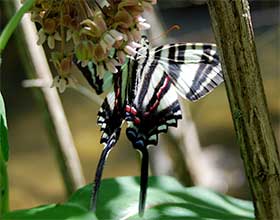
 Ohio’s half-dozen swallowtail butterfly species — black, giant, pipevine, spicebush, tiger, and zebra — are large, showy, and beautiful. But if we step back from their visual appeal, the group also provides a platform for exploring many facets of biology. To identify a few related to ecology:
Flowering plants and insects need each other.
Like most butterflies, swallowtails have evolved a mutually beneficial relationship — a mutualistic symbiosis — with flowering plants. Plants produce sugary nectar, which constitutes a swallowtail’s primary food. In the process of retrieving that “bribe”, the butterfly helps the plant reproduce by transferring pollen from flower to flower. Swallowtails are generalist pollinators; they have no special mechanism for carrying pollen (it just sticks to their body or wings) and they visit a wide array of flowers. However, their large size does provide certain advantages. They move far and fast, so they can effectively visit widely dispersed flowers. And they have long tongues (proboscis length in butterflies increases with body size), so they can effectively feed from and pollinate flowers like cardinal flowers and larkspurs with deep tubular structures.
Producers (plants) and consumers (caterpillars) are in an evolutionary arms race.
Many plants defend themselves from herbivores like caterpillars by producing distasteful and/or toxic chemicals. An insect that tolerates those chemicals thereby gains access to a competitor-free food resource. Among Ohio’s swallowtails, caterpillars of five species have mechanisms to tolerate chemical “cocktails” produced by particular plants, and they use those plants as hosts. Pipevine swallowtail larvae feed on pipevine and relatives, spicebush swallowtails on laurel family plants (spicebush and sassafras), giant swallowtails on the rue family (mostly hoptree), zebra swallowtails on pawpaw, and black swallowtails on the carrot family (e.g., golden alexanders or angelica in the wild, carrots, dill, or parsley in the garden). Only the tiger swallowtail has generalist caterpillars, consuming leaves of willow, ash, cottonwood, and others. As a side benefit to pipevine swallowtails, the chemicals they consume are substantially toxic to vertebrates. Those toxins are sequestered by the caterpillar and retained through metamorphosis; the butterflies thereby become distasteful to predators like birds.
You can fool Mother Nature!
Predators that know to avoid toxic pipevine swallowtails may also avoid similar-looking species. Black and spicebush swallowtails, which do not incorporate toxins, have evolved coloration that mimics pipevine swallowtails (more similar-looking individuals are more likely to survive and leave offspring). In tiger swallowtails, all males and many females are yellow, but some females are dark and resemble their pipevine cousins. Dark females are more common in regions with more pipevine swallowtails.
Some swallowtail caterpillars also benefit from mimicry and deception. Both tiger and spicebush swallowtail caterpillars sport fake eyes that resemble snakes, presumably deterring predators. And giant swallowtail caterpillars strongly resemble bird droppings; who would attack that?!
Traits that promote reproductive success can outweigh their detriment to survival.
To pass genes to the next generation, an organism must survive and reproduce; but sometimes those objectives conflict. Black female tiger swallowtails survive better, but male tiger swallowtails — for some reason — prefer yellow females. So, the yellow female form usually predominates. Coloration represents a tradeoff between reproductive success and survivorship (the male peacock’s tail is another famous example). Tradeoffs are another good lesson from ecology!
Geographic range limits depend on both biotic and abiotic factors.
Historically, Ohio has been near the northern end of the range for giant and zebra swallowtails. That northern limit partly reflects cold tolerance. For swallowtails, it’s the pupae (chrysalis stage) that overwinter and must survive sub-freezing conditions. To achieve that, they turn down most aspects of metabolism so they can survive on stored energy, and they accumulate sugars, especially trehalose, that allow them to remain ice-free, alive and unfrozen, down to -25oC (-10oF) or colder. Pupae of more northerly distributed swallowtails tolerate slightly colder temperatures. Warmer winters in recent decades are allowing survival further north.
A second factor that constrains swallowtail ranges is the availability of their caterpillar host plants. Again, changing climate is allowing some of those host plants, including hoptree (for giant swallowtails) and pawpaw (for zebra swallowtails), to expand northward. Those two swallowtail species are among the 20% or so of butterflies that have increased in abundance in Ohio over the past 20 years, while more than twice as many species, and butterfly abundance overall, have significantly decreased.
Swallowtail butterflies have a lot to teach us.
They may not elicit the same level of connection and empathy as the central figure in the documentary My Octopus Teacher. But still, they can help to impart a variety of lessons about the natural world. We just need to pay attention.
Article and photo contributed by Dr. David L. Goldstein, Emeritus Professor, Department of Biological Sciences, Wright State University.