
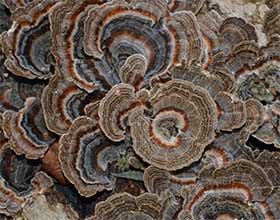
 This time of year, the words “turkey tail” probably bring to mind a bird destined for a holiday platter (or perhaps a pardon!). But while you very well might encounter a wild turkey out in our local woods, there’s another variety of turkey tail that won’t scamper out of view: Trametes versicolor, the turkey tail fungus.
Mushrooms and other fungi are notoriously challenging to identify. Fortunately, turkey tail has some distinctive features. While much of the turkey tail organism consists of fine filaments called hyphae that infiltrate wood and soil, the prominent visible growth presents as tough, woody brackets growing on dead or decaying wood. The upper surfaces of those brackets display bands of various colors, from brown and white to purple and orange, conferring the resemblance to a feathered turkey’s tail. The bracket’s underside, in contrast, is dull whitish brown, with a multitude of tiny holes that reflect this fungus’ membership in the polypore family. The reproductive cells of the fungus—spores—are released from those pores.
Despite those distinctive traits, it has taken a while to figure out the relationships of turkey tail to other fungi. The fungus now formally named Trametes versicolor was previously known as Boletus versicolor, Coriolus versicolor, Polystictus versicolor, and Polyporus versicolor, each name reflecting the evolving understanding of fungal diversity. The fungus didn’t change, just our understanding of the fungus.
Nowadays, DNA sequencing provides more definitive answers about fungal relationships. But microscopic anatomy helps, too. The Wikipedia description of Trametes gives an idea of how complex those fungal features can be. According to the first sentence of that article, Trametes is distinguished by “a pileate basidiocarp” (meaning that it has a spore-producing cap-like structure), “di- to trimitic hyphal systems” (meaning that it produces two or three varieties of fungal filaments), “smooth non-dextrinoid spores” (meaning that the reproductive cells—spores—do not turn brown when exposed to iodine-containing dye), and “a hymenium usually without true hymenial cystidia” (meaning that the spore-bearing surface lacks the large cells known as cystidia). Wow!
Functionally, turkey tail is classified as a saprophyte, meaning that it contributes to the decomposition of dead wood. That decomposition represents a critical role of fungi in the ecosystem, helping to recycle organic matter from fallen trees back into the environment. Turkey tail falls into the “white rot” version of saprophytes. The structure of wood is substantially formed from fibers of the carbohydrates cellulose and hemicellulose, bound together by a complex biopolymer known as lignin. Turkey tail fungi produce enzymes that are particularly effective at digesting lignin; the result is a white-colored, cellulose-based residual decay. In contrast, “brown rot” fungi most effectively digest cellulose and leave behind a brown-colored, lignin-based decay.
The ecological role of decomposers depends on the secretion of digestive enzymes, and some of those enzymes have found practical application in human activities. The enzymes known as laccases, responsible for the fungal ability to digest lignin, have been of particular utility. Among their many uses are detoxification of pollutants like industrial dyes and pesticides, and methods to bleach paper pulp without chlorine. Industrial cultivation of Trametes continues to be developed and optimized and depends on factors like genetic characteristics of fungal strains, substrate composition, and operating conditions such as oxygen levels.
The chemical constituents of turkey tail, particularly various forms of polysaccharides and their derivatives, also contribute to their use in human healthcare. The woody brackets are tough and not particularly appealing as food. However, concoctions of turkey tail—typically ingested as a tea or extract—have long been used as therapeutics, particularly in Asia but also in the West. The list of purported benefits is long, including actions against inflammation, oxidative damage, hyperlipidemia, some forms of cancer, and others. In the US, preparations of turkey tail fungus are widely available over the counter, typically marketed as dietary supplements and thereby unregulated by the FDA for purity, efficacy, side effects, or dosage. Caveat emptor!
Turkey tail fungi form beautiful displays and play invaluable roles in forest ecology. Their contribution to human endeavors is equally well secured—unquestionably so for industrial processes, and quite possibly for health and wellness. In this end-of-year holiday season, we should remember that the “lower organisms” in our environment contribute much to our well-being. Let us give thanks!
Article and photo contributed by Dr. David L. Goldstein, Emeritus Professor, Department of Biological Sciences, Wright State University.